RPA in Yambo: local field effects
In this tutorial you will learn how to calculate the macroscopic dielectric function with Yambo using two-dimensional (2D) hBN as an example.
Requirements
SAVEfolder of 2D hBN: download and extracthBN-2D.tar.gzfrom the Tutorial files pageyamboexecutablegnuplotfor plotting spectra
It is assumed that you are familiar with the concepts related to the SAVE folder and handling files with Yambo.
The macroscopic dielectric function is obtained by including the so called local field effects (LFE) in the calculation of the response function.
Within the time-dependent DFT formalism this is achieved by solving the Dyson equation for the susceptibility \(\chi\). In reciprocal space this is given by:
The microscopic dielectric function is related to \(\chi\) by
and the macroscopic dielectric function is obtained by taking the \(\mathbf{G}=\mathbf{G^{\prime}}=0\) component of the inverse microscopic one
Experimental observables like the optical absorption and the electron energy loss are obtained from the macroscopic dielectric function. The optical absorption is in particular defined in the optical limit:
The electron energy loss, on the other hand, can be probed in experiments even outside of the optical limit:
In the following we will neglect the \(f_{\mathbf{G}_1,\mathbf{G}_2}^{xc}\) term in the kernel: we perform the calculation at the RPA level including just the Hartree term (from \(v_G\)).
If we also neglect the Hartree term we go back to the independent particle approximation since we effectively remove the kernel and set \(\chi = \chi_0\).
Before starting go to the hBN-2D/YAMBO directory and initialize the SAVE folder:
$ cd hBN-2D/YAMBO
$ ls
SAVE
$ yambo
Input file and parameters
After the initialization we can generate the input file.
To include the local fields variables use -o c -k hartree.
Check the meaning of the options with the command-line interface
if you are not familiar with them.
Let’s start doing a calculation with the light polarization \(\mathbf{q}\) in the plane of the BN sheet. Generate the input like this
$ yambo -F yambo.in_RPA -V RL -o c -k hartree
(thus naming it yambo.in_RPA) and
then set the following variables to these values:
 FFTGvecs=  3951            RL       # [FFT] Plane-waves
 Chimod= "Hartree"                   # [X] IP/Hartree/ALDA/LRC/BSfxc
 NGsBlkXd=  3        Ry              # [Xd] Response block size
 % QpntsRXd
  1 | 1 |                            # [Xd] Transferred momenta
 %
 % EnRngeXd
  0.00000 | 20.00000 | eV            # [Xd] Energy range
 %
 % DmRngeXd
  0.20000 | 0.200000 | eV            # [Xd] Damping range
 %
 ETStpsXd= 2001                      # [Xd] Total Energy steps
 % LongDrXd
 1.000000 | 0.000000 | 0.000000 |    # [Xd] [cc] Electric Field
 %
In this input file:
We evaluate the \(\mathbf q \to 0\) response function choosing the direction in the limit parallel to the plane of the hBN sheet;
We set the energy range for the spectrum to \(0-20\) eV;
We set the broadening through the variable
DmRngeXd;We select the Hartree kernel;
Note
While FFTGvecs controls the cutoff for the plane wave expansion of the wavefuntions
(hidden in dipole matrix elements appearing in the expression of \(\chi_0\)),
NGsBlkXd determines the size of the dielectric matrix in G-space (or equivalently
the cutoff on the sum over \(\mathbf{G}_1, \mathbf{G}_2\) in Eq. (1)).
Remember that NGsBlkXd is a typical parameter to be converged while it is better to
not modify FFTGvecs and leave it at its default (maximum) value.
LFE in the periodic direction

Atomic structure of 2D hBN (\(z \parallel c\) is the non-periodic direction).
Let’s now run the calculation choosing an appropriate job string label, e.g. one that specifies the electric field direction:
$ yambo -F yambo.in_RPA -J q100
This calculation should take a couple of minutes in serial.
yambo -F yambo.in_RPA -J q100 (v5.3 log)
 ___ __  _____  __ __  _____   _____
|   Y  ||  _  ||  Y  ||  _  \ |  _  |
|   |  ||. |  ||.    ||. |  / |. |  |
 \_  _/ |. _  ||.\_/ ||. _  \ |. |  |
  |: |  |: |  ||: |  ||: |   \|: |  |
  |::|  |:.|:.||:.|:.||::.   /|::.  |
  `--"  `-- --"`-- --"`-----" `-----"


 <---> [01] MPI/OPENMP structure, Files & I/O Directories
 <---> MPI Cores-Threads   : 1(CPU)-48(threads)
 <---> [02] CORE Variables Setup
 <---> [02.01] Unit cells
 <---> [02.02] Symmetries
 <---> [02.03] Reciprocal space
 <---> [WARNING] wf_ng > maxval(wf_igk), probably because FFTGvecs in input. Reducing it
 <---> [02.04] K-grid lattice
 <---> Grid dimensions      :   6   6
 <---> [02.05] Energies & Occupations
 <---> [03] Transferred momenta grid and indexing
 <---> [04] Dipoles
 <---> [04.01] Setup: observables and procedures
 <---> [DIP] Database not correct or missing. To be computed
 <---> [x,Vnl] computed using 2 projectors
 <---> R V P [g-space] |########################################| [100%] --(E) --(X)
 <---> [WARNING] [r,Vnl^pseudo] included in position and velocity dipoles.
 <---> [WARNING] In case H contains other non local terms, these are neglected
 <---> [05] Optics
 <---> [LA] SERIAL linear algebra
 <---> [MEMORY] Alloc X_par%blc( 225.8940 [Mb]) TOTAL:  231.1780 [Mb] (traced)  241.4480 [Mb] (memstat)
 <---> [MEMORY] Alloc WF%c( 70.87500 [Mb]) TOTAL:  303.6860 [Mb] (traced)  312.3240 [Mb] (memstat)
 <---> [FFT-X] Mesh size:   12   12   75
 <---> [X-CG] R(p) Tot o/o(of R):   1464   8064    100
 <02m-07s> Xo@q[1] |########################################| [100%] 02m-06s(E) 02m-06s(X)
 <04m-33s> X@q[1] |########################################| [100%] 02m-24s(E) 02m-24s(X)1800 [Mb] (memstat)
 <04m-33s> [MEMORY]  Free M_par%blc( 225.8940 [Mb]) TOTAL:  305.6910 [Mb] (traced)  570.1800 [Mb] (memstat)
 <04m-34s> [MEMORY]  Free M_par%blc( 225.8940 [Mb]) TOTAL:  79.54800 [Mb] (traced)  344.2840 [Mb] (memstat)
 <04m-34s> [MEMORY]  Free WF%c( 70.87500 [Mb]) TOTAL:  8.673000 [Mb] (traced)  118.3880 [Mb] (memstat)
 <04m-34s> [06] Timing Overview
 <04m-34s> [07] Memory Overview
 <04m-34s> [08] Game Over & Game summary
Let’s now look at the results. We want to compare the absorption with
and without the local fields: by inspecting the output file o-q100.eps_q1_inv_rpa_dyson
we find that this information is given in the 2\(^{nd}\) and 4\(^{th}\)
columns, respectively:
$ head -n 50 o-q100.eps_q1_inv_rpa_dyson | grep '#' | tail -n 3
#
#    E[1] [eV]          Im(eps)            Re(eps)            Im(eps_o)          Re(eps_o)
#
Plot the RPA and the IPA response:
 $ gnuplot
 $ gnuplot> plot "o-q100.eps_q1_inv_rpa_dyson" u 1:2 w l t "RPA-LFE","o-q100.eps_q1_inv_rpa_dyson" u 1:4 w l t "noLFE", "o-q100.eel_q1_inv_rpa_dyson" u 1:4 w l ls 7 dt 2 t "EELS"
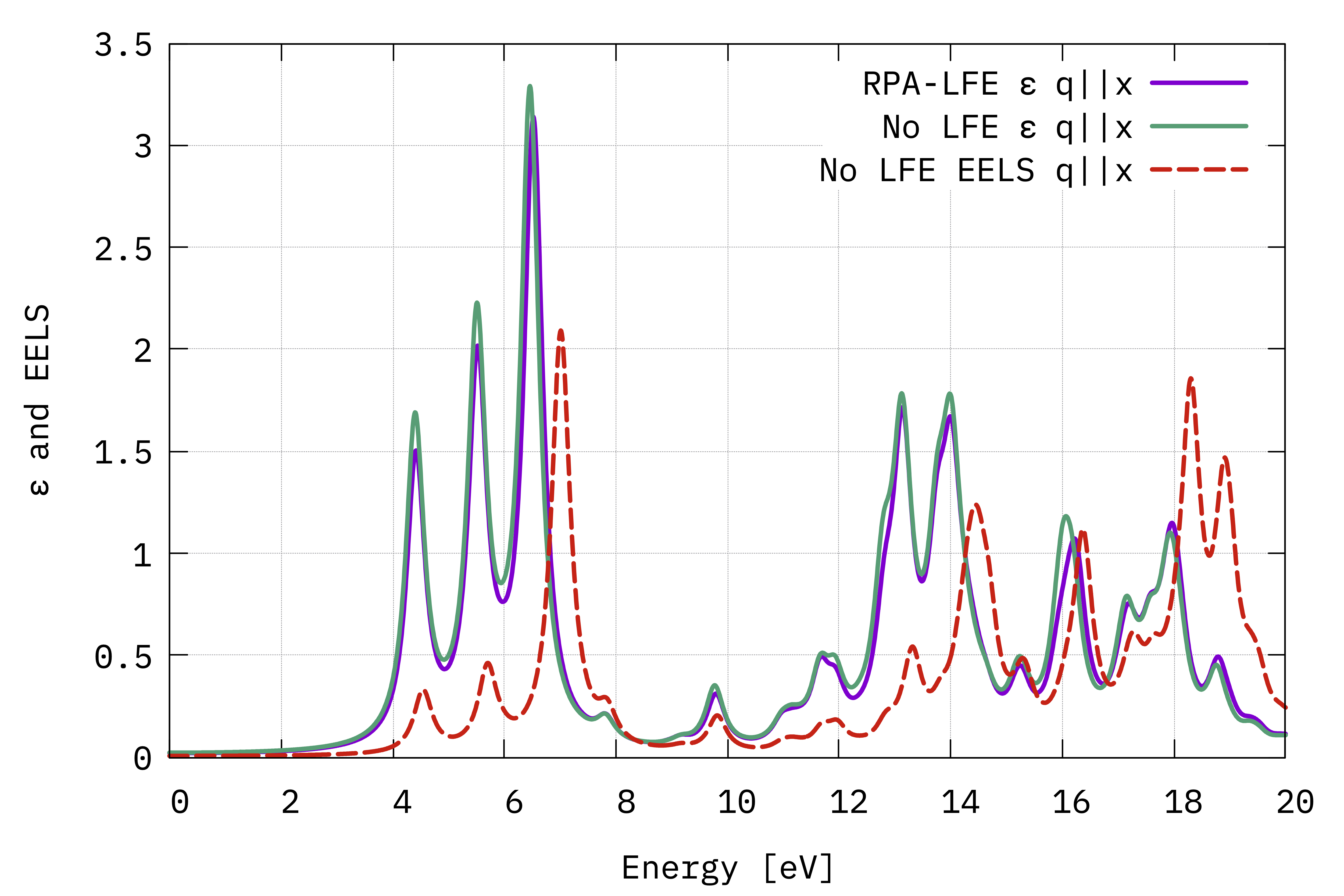
Absorption and EELS spectra (in the optical limit) from the macroscopic dielectric function (Eq. (4) and Eq. (5)) with the electric field in the in-plane direction.
There is very little influence of local fields for 2D hBN. This is generally the case for semiconductors or materials with a smoothly varying electronic density.
In the same figure, we have also shown the EELS spectrum (o-q100.eel_q1_inv_rpa_dyson) for comparison.
Remark on IP/RPA absorption
From the plot in the graph above, it may seem that the IP and RPA absorption spectra coincide.
Actually, plotting the difference between the two, i.e. the difference between Im(eps) and Im(eps_o), you can clearly see that the spectral weight is redistributed.
However the integral must remain the same because the underlying response functions (either IP or RPA), from which they stem, both satisfy the f-sum rule[1].
LFE in the non-periodic direction
Now let’s orientate \(\mathbf{q}\) in the direction perpendicular to the BN plane.
Open the input file yambo.in_RPA and change LongDrXd to:
% LongDrXd
0.000000 | 0.000000 | 1.000000 |        # [Xd] [cc] Electric Field
%
Run the calculation (don’t forget to change the -J label):
$ yambo -F yambo.in_RPA -J q001 >& /dev/null &
The >& /dev/null & makes Yambo run in the background and print the log into a file.
You can follow the progress of the calculation with
$ tail -f l-q001_optics_dipoles_kernel_chi
When the calculation is done we can plot the new output:
$ gnuplot
gnuplot> plot "o-q001.eps_q1_inv_rpa_dyson" u 1:2 w l,"o-q001.eps_q1_inv_rpa_dyson" u 1:4 w l
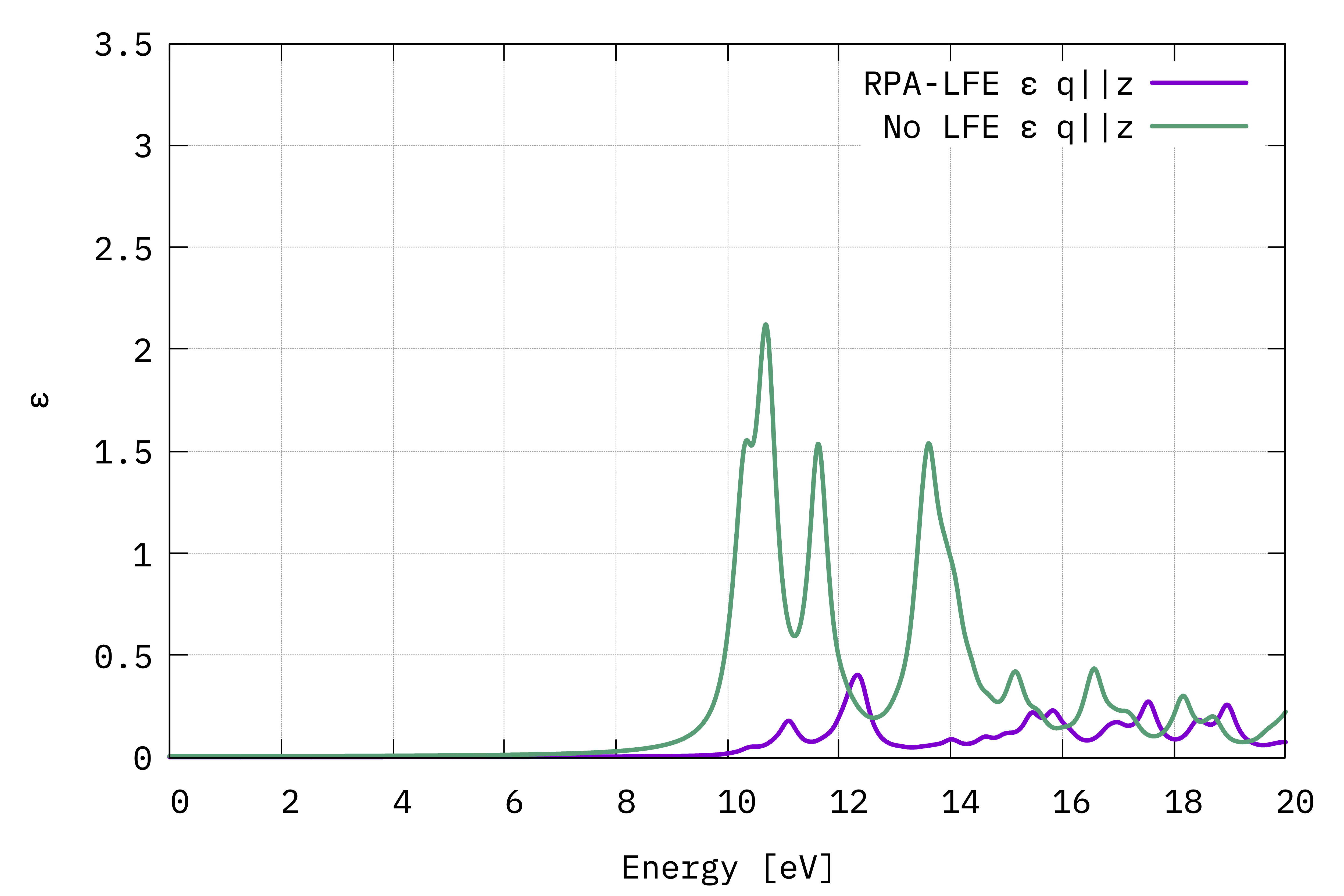
Absorption spectra from the macroscopic dielectric function (Eq. (4)) with the electric field in the out-of-plane direction.
In the out of plane direction, the absorption is strongly blueshifted with respect to the in-plane absorption. Furthermore, the influence of local fields is striking and quenches the spectrum strongly. This is the well known depolarization effect.
Local field effects are much stronger in the perpendicular direction because the charge inhomogeneity is dramatic. Also keep in mind that many G-vectors are needed to account for the sharp change in the potential across the BN-vacuum interface.
Absorption vs EELS
In order to understand this further, we plot the electron energy loss spectrum for this component and compare with the absorption:
$ gnuplot
$ gnuplot > plot "o-q001.eps_q1_inv_rpa_dyson" w l,"o-q001.eel_q1_inv_rpa_dyson" w l
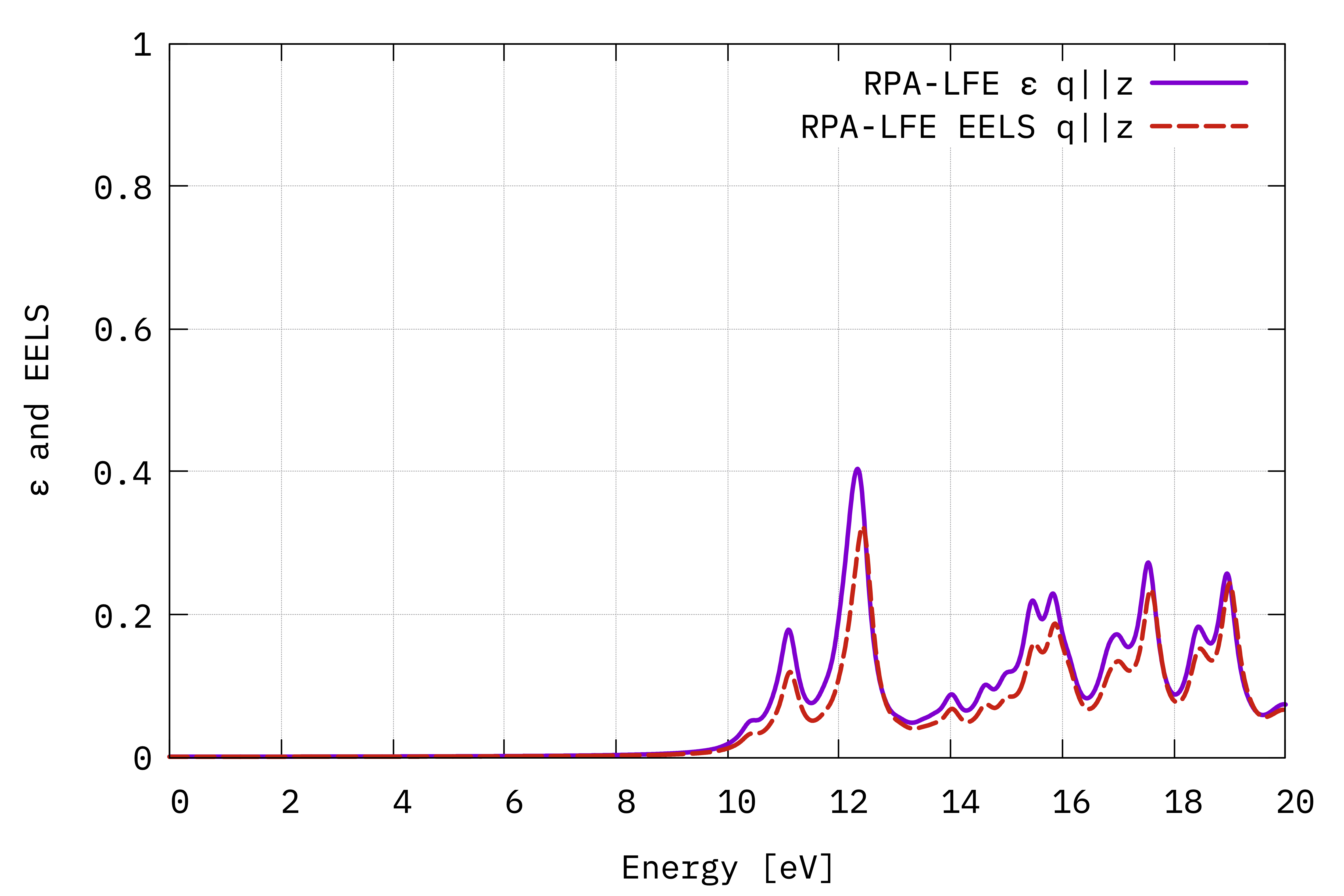
Absorption and EELS spectra (in the optical limit) from the macroscopic dielectric function (Eq. (4) and Eq. (5)) with the electric field in the out-of-plane direction.
The conclusion is that the absorption and EELS coincide for isolated systems. To understand this result, you need to consider the role of the macroscopic screening in the response function and the long-range part of the Coulomb potential. See e.g. this article[2]
Note
In order to have exactly coinciding EELS and absorption spectra here, we actually need to include the truncation of Coulomb interaction (using the -r flag when generating the input).
The Coulomb cutoff is needed because we did not include enough vacuum along the non-periodic stacking direction, which results in spurious interactions between periodic replicas.
The erroneous difference is proportional to the volume of the unit cell, reflecting the fact that the finite number of \(\mathbf{G}\) vectors along the \(z\) direction (too low since we have not enough vacuum) spoils the value of \(\epsilon_{00}^{-1}\) and eventually also of \(\epsilon_{00}\) after the inversion.
With the Coulomb cutoff, instead, the \(\mathbf{G}\) vectors along \(z\) are effectively continuous (as it is equivalent to having infinite vacuum).
Finally, notice that when you use the Coulomb cutoff Yambo does not produce two different output files o.eps_* and o.eel_*, but a single output file o.alpha_*: the correct physical quantity to calculate in 2D is the 2D polarisability.
EELS Dispersion (optional)
We can also calculate the EELS dipersion by performing the RPA calculations at finite momenta \(\mathbf{q}\).
Note
To clearly see the EELS dispersion we need to increase the k-points sampling of the Brillouin zone. For the results shown in the following, we increased the grid to \(18 \times 18 \times 1\) and the cutoff for the dielectric matrix to 10 Ry. Be aware that this makes the calculation much heavier, so you might want to use different parameters (k-point grid, energy cutoff, number of bands…) to be able to run it on your machine.
To do this we increase the range of calculated \(\mathbf{q}\) points via QpntsRXd and it is sufficient to focus on a narrower energy window.
We also want to include the cutoff of the Coulomb interaction for 2D materials, so generate a new input file with
$ yambo -F yambo.in_eels -r -o c -k hartree
and change the highlighted input variables as shown here:
[...]
rim_cut                          # [R] Coulomb potential
chi                              # [R][CHI] Dyson equation for Chi.
dipoles                          # [R] Oscillator strenghts (or dipoles)
[...]
RandQpts=1000000                 # [RIM] Number of random q-points in the BZ
RandGvec= 100              RL    # [RIM] Coulomb interaction RS components
CUTGeo= "slab z"                 # [CUT] Coulomb Cutoff geometry: box/cylinder/sphere/ws/slab X/Y/Z/XY..
[...]
Chimod= "HARTREE"                # [X] IP/Hartree/ALDA/LRC/PF/BSfxc
NGsBlkXd= 10               Ry    # [Xd] Response block size
% QpntsRXd
   1 |  6 |                         # [Xd] Transferred momenta
%
% BndsRnXd
   1 |  60 |                         # [Xd] Polarization function bands
%
% EnRngeXd
  3.00000 | 12.00000 |         eV    # [Xd] Energy range
%
% DmRngeXd
 0.200000 | 0.200000 |         eV    # [Xd] Damping range
%
ETStpsXd= 2001                    # [Xd] Total Energy steps
% LongDrXd
 1.000000 | 0.000000 | 0.000000 |        # [Xd] [cc] Electric Field
%
In this way, we will find the EELS spectra for a finite number of \(\mathbf{q}\) vectors along the \(\Gamma-M\) direction.
Now run the calculation:
$ yambo -F yambo.in_RPA -J eels -C eels.out
We can finally plot the spectra, which are now printed in the files o-eels.alpha_q1_inv_rpa_dyson, o-eels.alpha_q2_inv_rpa_dyson and so on (there are no longer o.eps* and o.eel* files because we used the Coulomb cutoff).
Notice that here we plot the normalized EELS dispersion, as generally EELS spectra have very different intensities at different \(\mathbf{q}\).
You can use the provided plt_eels.gnu script.
plt_eels.gnu
Copy the following lines in a file named plt_eels.gnu and then plot the spectra with the command load 'plt_eels.gnu' in gnuplot.
fil1='o-eels.alpha_q1_inv_rpa_dyson'
stats fil1 using 2 name "Y1" nooutput
nor1=Y1_max

fil2='o-eels.alpha_q2_inv_rpa_dyson'
stats fil2 using 2 name "Y2" nooutput
nor1=Y2_max

fil2='o-eels.alpha_q2_inv_rpa_dyson'
stats fil2 using 2 name "Y3" nooutput
nor3=Y3_max

#[...]

p   fil1 u 1:(0.0+$2/nor1) w l lw 3 t 'q1'
rep fil2 u 1:(1.0+$2/nor2) w l lw 3 t 'q2'
rep fil3 u 1:(2.0+$2/nor3) w l lw 3 t 'q3'
#[...]
The values nor1, nor2 etc. are the maxima of the Im(alpha) column of the corresponding file.
These are needed to normalize the intensity of each plot, which makes the comparison easier.
You can get these values also via bash commands. For example, for q1:
$ grep -v '#' o-eels.alpha_q1_inv_rpa_dyson | awk '{print $2}' | sort -nr | head -n 1
6.330149
Keep in mind that these values do in general change depending on the k-point grid and energy cutoff values that you set.
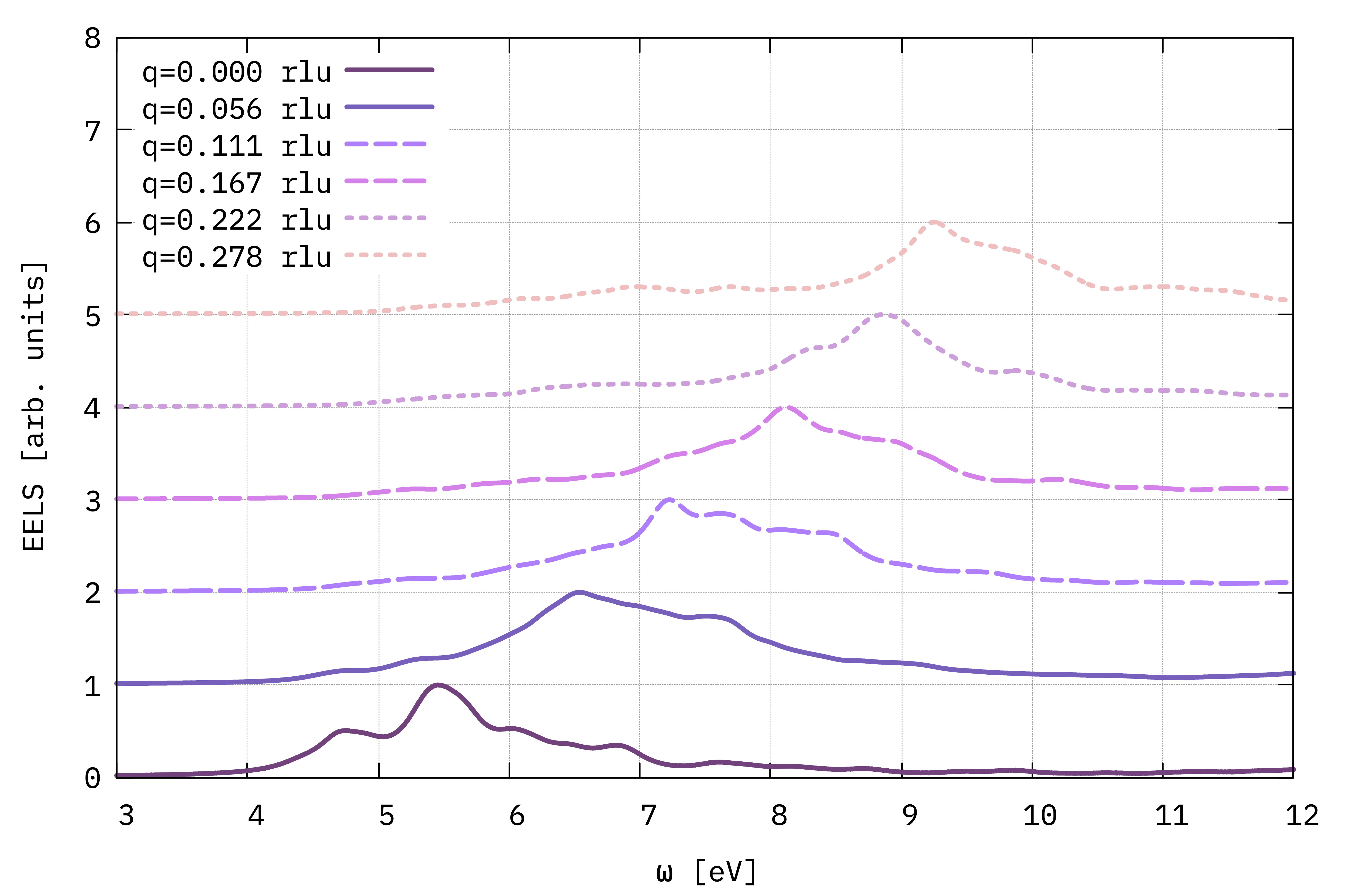
Dispersion in momentum of the EELS spectra for \(\mathbf{q}\) along the \(\Gamma-M\) direction, calculated from the macroscopic dielectric function (Eq. (5)).
Despite not being fully at convergence, we can already draw conclusions on the typical result of a EELS spectra. This in particular gives access to the evolution with respect to the \(\mathbf{q}\) of the neutral excitations of a material. In the figure shown just above, by following the position in energy of the main peaks we can observe the dispersion in energy of the first allowed single-particle transitions of 2D h-BN.
An EELS spectrum can also provide information on the charge neutral excitations of a material, the plasmons, which are the peaks found in correspondence of \(\text{Re} \epsilon_M=0\).